


Environmental Science
About | Courses | Faculty | Print
With the increasing pressure from the public about air and water pollution, nuclear waste disposal, and global warming, there is an increased need for professionals in Environmental Studies. At UIU, you have the opportunity to make a difference and help our planet through science.
Through your studies, you will become conversant in physics, chemistry, biology, ecology and geology. Since social, economic and political science are all essential to understanding not only how humans affect the environment, but also what options are available for action, you will learn how to solve an environmental problem by applying your knowledge.
Environmental Science majors have the opportunity to pursue many careers including work with state and local governmental agencies, such as the Bureau of Land Management, National Park Service, Natural Resources Conservation Service, state, federal, and local wildlife agencies and county conservation boards; or private consulting firms, such as civil engineering firms, environmental consulting firms, and natural resource planning companies.
Upper Iowa University graduates are currently working for natural-resource employers across Iowa, as well as Illinois, Colorado, Idaho, Montana, and Nebraska.
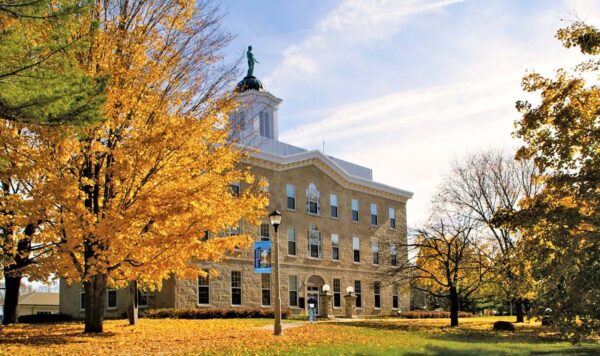
LOCATION: Main residential campus in Fayette, Iowa
MAJOR IN ENVIRONMENTAL SCIENCE
Core Requirements:
- (3) ES 100 Introduction to Geology
- (1) ES 101 Introduction to Geology Lab
- (3) BIO/ES 161 Intro to Environmental Science
- (4) ES 315 Remote Sensing and GIS
- (4) ES 326 Soil Genesis, Classification, Morphology
- (4) BIO 135 Principles of Biology I
- (4) BIO 335 Ecology
- (2) BIO 496 Senior Project
Supporting Core Requirements:
- (4) CHEM 151 General Chemistry I
- (4) PHY 111/112 Physics I/Lab
- (3) MATH 220 Elementary Statistics
- (3) MATH 111 Pre-Calculus OR MATH 120 Calculus I
- (4) CHEM 152 General Chemistry OR PHY113/114 Physics II/Lab
Three of the following (At least one must be 4 hours): (10-12)
- ES 316 Geomorphology
- ES 330 Global Warming & Climate Change
- ES 417 Hydrogeology
- BIO 210 Microbiology
- BIO 315 Ichthyology
- BIO 365 Conservation Biology
- BIO 393 Herpetology
- BIO 385 Ornithology
- BIO 391 Mammalogy
- BIO 403 Field Internship
- BIO 410 Plant Taxonomy
- BIO 490 Entomology
One of the following: (4)
- BIO 110 General Zoology
- BIO 120 General Botany
- BIO 140 Principles of Biology II
Total: 57-59 credits